
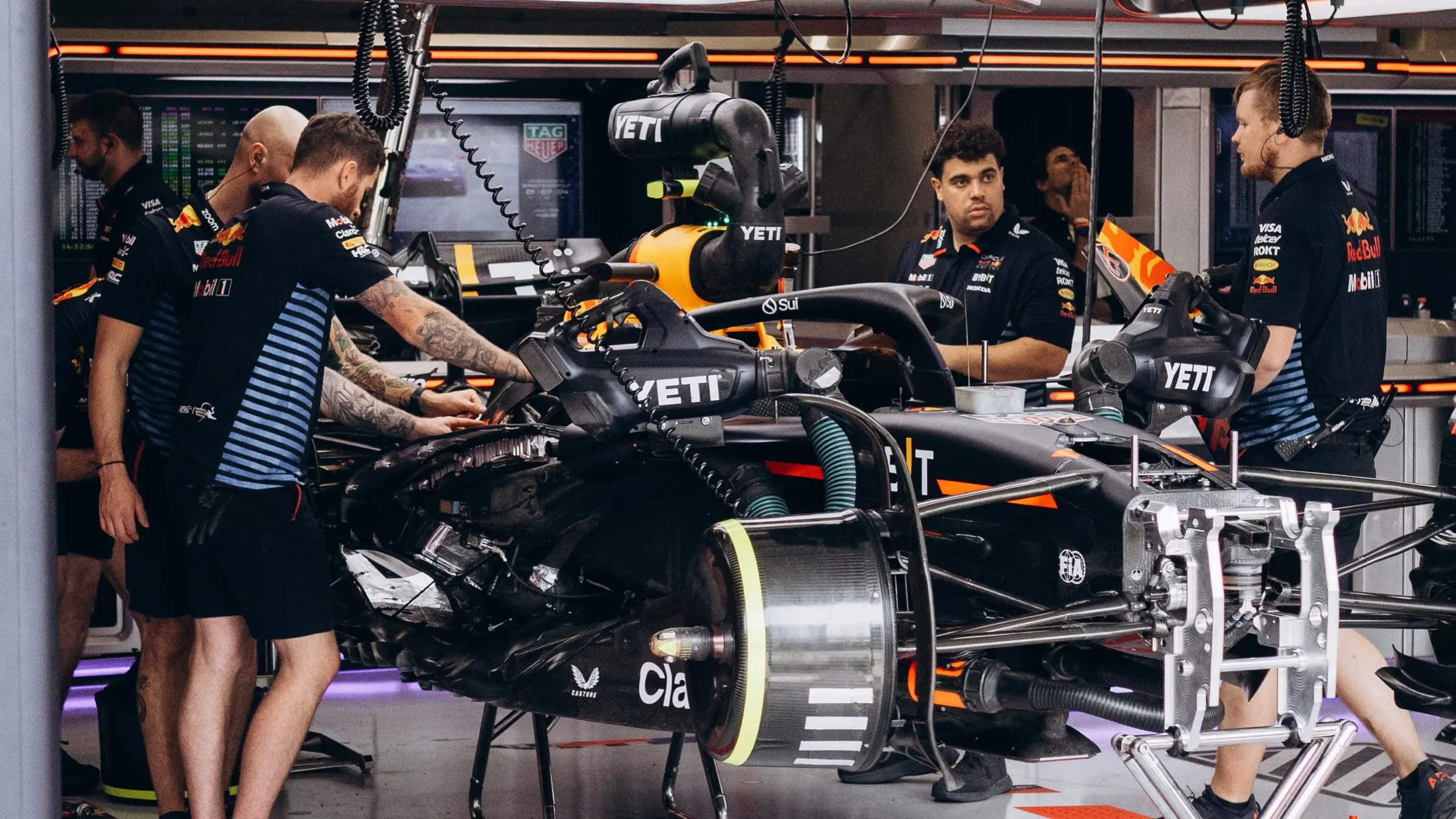
If you want to work in Formula 1, the first question to ask yourself probably isn't which team you'd love to join. It's what you could actually do for them.
The sport is famous for its drivers, engineers and mechanics. But behind every race weekend is an enormous amount of work that never makes it onto television. Software development, finance, marketing, logistics, commercial partnerships and event operations all play a part.
And that creates opportunities for people whose professional backgrounds have little to do with racing.
So, where do you start? We looked at the opportunities currently tracked by SportAtlas, explored how Formula 1 organisations recruit, and identified some of the career paths worth considering.[1][2]
What the Formula 1 job market actually looks like
On 29 October 2026, SportAtlas tracked 94 professional job opportunities across seven Formula 1 teams and Formula 1's commercial organisation.
Engineering remains central to the sport. Of those 94 listings, 55 contained the words Engineer or Engineering in their job titles.
The other 39 illustrate something that job seekers sometimes overlook: an F1 organisation needs considerably more than engineering talent.
Among the positions appearing in our index were a Senior Marketing Manager at Aston Martin F1, a Senior Finance Business Partner at McLaren Racing and a Senior Account Executive specialising in gaming and esports at Formula 1.
These are real examples from our October snapshot, not hypothetical career suggestions.
The takeaway? You don't necessarily need to change your profession to enter Formula 1. You may need to find where your existing profession fits within the sport.
Five career paths worth exploring
1. Engineering and vehicle development
Engineering is the most visible technical route into F1, and for good reason.
Teams employ specialists in aerodynamics, mechanical design, vehicle dynamics, composite materials, control systems and manufacturing. Their work ranges from designing individual components to improving the reliability and performance of the entire car.
Relevant technical qualifications, practical experience and evidence of engineering problem solving matter here.
If you're studying engineering, projects that involve designing, building, testing or analysing real systems can give employers something tangible to evaluate.
2. Software, technology and data
Formula 1 is also a technology business.
Teams depend on software developers, systems engineers, IT specialists and data professionals to support everything from simulation and performance analysis to the infrastructure needed across their operations.
Our snapshot included Software Engineer, IT Support and Graduate Data Scientist roles.
For candidates already working in technology, this can be a particularly interesting route. Not every position requires previous motorsport experience, although specific technical requirements vary considerably.
3. Marketing, communications and commercial partnerships
The commercial side of Formula 1 extends far beyond sponsorship logos on a car.
Teams and championship organisations work with global partners, develop commercial campaigns, manage fan relationships and produce content for audiences around the world.[2]
That creates opportunities in digital marketing, brand management, partnerships, communications, content production and commercial sales.
Someone with experience growing an audience, managing marketing investments or delivering partnership campaigns may already have skills relevant to these functions.
The challenge is demonstrating how that experience could translate into the sports industry.
4. Operations, logistics and event delivery
A race weekend is only the visible end of a much larger operation.
Equipment must arrive, technical systems must work, staff and suppliers must coordinate, and events need to run to demanding schedules.
This creates roles in project management, procurement, supply chain, event operations and technical support.
Some positions involve regular international travel. Others are based primarily at company headquarters.
Understanding that distinction is important if your goal is to work in motorsport but you have specific preferences about location or lifestyle.
5. Finance, people and corporate functions
This is perhaps the least glamorous category from a fan's perspective, but it's an essential part of running a Formula 1 organisation.
Teams need financial planning, accounting, recruitment, legal expertise and organisational development just like other international businesses.
If you're already established in one of these professions, entering F1 might be a career transition rather than starting again.
That doesn't mean competition is any less demanding. It means your existing experience may be relevant.
Where are Formula 1 jobs located?
The United Kingdom remains particularly prominent in our October snapshot.
Of the 94 professional opportunities analysed, 67 had a UK country classification. Seven were classified in Switzerland, three in Germany and two in Italy. Another 15 did not have a country classification.
This distribution reflects the employers and vacancies monitored by SportAtlas, rather than a complete geographical census of Formula 1 employment.
Still, location deserves attention early in your search. Many technical positions require working at a specific facility, and international applicants should check work authorisation and relocation requirements before applying.
How can you get into Formula 1 without previous motorsport experience?
There isn't one route that works for everyone.
If you're at the beginning of your career, look into graduate programmes, industrial placements, apprenticeships and work experience opportunities.[3]
Williams Racing, for example, has dedicated early career programmes covering both technical disciplines and business services. Its recruitment guidance also makes clear that previous Formula 1 experience is not necessarily a requirement.[3][4]
If you're already working in another industry, start by looking for roles that overlap with what you know.
A software engineer doesn't necessarily need to become a vehicle dynamics specialist. A marketing professional doesn't need to become a race strategist. A financial analyst doesn't need to know how to design a front wing.
What matters is understanding the requirements of the position you're applying for and showing evidence that you can meet them.
How to make your Formula 1 application stronger
A genuine interest in motorsport is valuable. But enthusiasm alone won't demonstrate that you can do the job.
Start with the actual job description.
Look closely at the responsibilities, required skills and experience. Then compare them with projects you've delivered, problems you've solved and results you've achieved.
For example, if you're applying for a data role, describe the analytical tools you've used and the decisions your work supported.
If you're applying for marketing, show what you've achieved through campaigns, audience growth or commercial projects.
If you're targeting engineering, make relevant technical work and practical projects easy to understand.
Williams Racing's early career guidance places particular emphasis on demonstrating impact rather than relying on job titles alone.[4]
The strongest application is not necessarily the one that talks most passionately about Formula 1. It's the one that gives the employer a clear reason to believe you can contribute.
Where to look for Formula 1 career opportunities
Start by exploring three parts of the industry.
Formula 1 teams: follow individual team career pages for engineering, technology, commercial and corporate positions.
Formula 1 itself: the championship's commercial organisation recruits across broadcasting, media, technology, events and business operations.[1][2]
The wider motorsport ecosystem: governing bodies, technology providers, suppliers and other racing championships can offer experience relevant to a longer term career in Formula 1.
Don't limit your search to vacancies containing the words Formula 1. Search by the professional function you want to pursue as well.
A relevant opportunity in motorsport technology or sports operations may be more useful for your career than an unrelated role at your favourite team.
Your next step
Working in Formula 1 is competitive, and there's no guaranteed route into the industry.
But the opportunities are broader than the jobs most people see during a Grand Prix.
Start with your skills. Understand the different organisations that make the sport work. Identify roles where your experience is relevant, and build evidence for the areas you want to develop.
Then keep an eye on the employers and career paths that matter to you.
Explore motorsport careers on SportAtlas
Browse companies, discover professional opportunities and follow the organisations you're interested in.
Research methodology
SportAtlas analysed a snapshot of 94 candidate visible professional job documents recorded on 29 October 2026 across seven monitored Formula 1 teams and Formula 1's commercial organisation.
The engineering title count includes advertisements containing engineer or engineering. Geographic figures use the country classifications available in the SportAtlas index.
The sample excludes employers outside this selected group and may include positions at those employers that do not directly support their Formula 1 racing programmes. Results are subject to changes in vacancies and classifications.
SportAtlas Jobs: Proprietary job index, 29 October 2026 (methodology above; this is a historical snapshot, not today's live jobs tally).
Explore the index
Explore sports, company profiles and career functions across SportAtlas.
Current opportunities
Turn your research into your next move.
Browse companies, discover professional opportunities and follow the organisations you're interested in.
Sources & References
- Formula 1: Careers
Formula 1
- Formula 1: Meet Our Teams
Formula 1
- Williams Racing: Early Careers
Williams Racing
- Williams Racing: Tips for Early Career Applications
Williams Racing